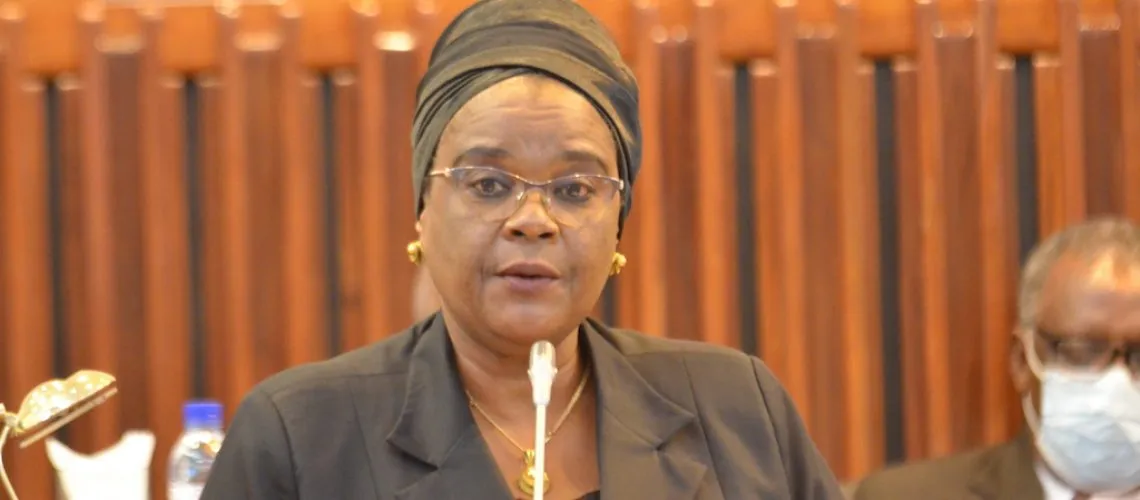
Although it was not entirely on the agenda, few expected that President Daniel Chapo would pick Carmelita Namashulua as the suitable candidate for the newly created post of Inspector General of State.
Thank you for reading this post, don't forget to subscribe!This has much less to do with Namashulua’s own personality than with her stint at the Ministry of Education, where scandals over serious errors in school textbooks tarnished her reputation.
It is possible that many of those who protest her appointment do not even know about her, but it is a fact that in public life, those who put themselves in the front-line risk being subject to the whims of judgment by the court of public opinion.
The truth is that despite a long career in the Civil Service, Namashulua has always a discreet figure, with a very distant visibility, until the textbook scandal broke.
In government circles, she made her debut in 2005 as Deputy Minister, before taking over as full Minister of State Administration and Civil Service in 2013. Until 2020, when she left for the Ministry of Education, Namashulua performed her duties without any stain.
It is arguable that she had any direct personal responsibility for the problems that occurred during her stint in Education. In fact, there is a criminal case that is taking its course at the Central Anti-Corruption Office (GCCC) in relation to the case, with some ministry officials being called to answer, which it is believed that in due course will bring all the answers.
But she will continue to bear the political responsibility related to the scandal, a risk closely related to public responsibility. Today, when she is appointed Inspector General of the State, she is once again tormented by something that was thought to have already passed into collective amnesia. The question that has been raised among critical sectors is whether, with the problems she brings from the Ministry of Education, she would be the ideal figure for the position.
Although unfair, this question has its degree of legitimacy. In fact, Namashulua is the victim of a system that is stubborn, so obstinate in its way of doing things that it is unable to comprehend any signs of public sentiment and act promptly in search of a balanced response.
The Ministry of Education is of such complexity that the production of the textbook of any given subject for a specific grade is just one of hundreds of other activities that take place there. The portfolio’s principal plays the role of political coordinator for all these activities, but for his or her performance will depend on the support of dozens of directors and other senior and junior officials who make that whole machine roll. It would perhaps be humanly impossible for the minister to have control down to the smallest detail over everything that happens in the ministry.
But in the Mozambican system, public inquiries are rarely seen as valuable management tools, not only in terms of searching for the material truth about what would have happened, but also from the point of view that knowledge of facts about situations that have gone wrong works as an important antidote to prevent the same mistakes from being repeated in the future.
In this case, an independent public inquiry would have detailed the entire process through which the textbook passed, stage by stage (from conception, proofreading to final approval), as well as the actors involved in each of those moments. This information, being publicly available, would dispel any doubt, and today we would be talking about the challenges of the work that lie ahead, not necessarily about whether Namahulua is fit for the job.
In fact, in a normal scenario, the GCCC’s action would have resulted from such an investigation, and not from a bureaucratic process that may even raise suspicions of having been made a tool precisely to evade public scrutiny and exonerate her from responsibility. As an Inspector, this will be a valuable lesson.